# Audiences

Audiences, segments, cohorts, buckets: call them what you will, but groups of users defined by your own events (or outside third-party events) are a critical tool for both measurement and (hopefully) targerting.

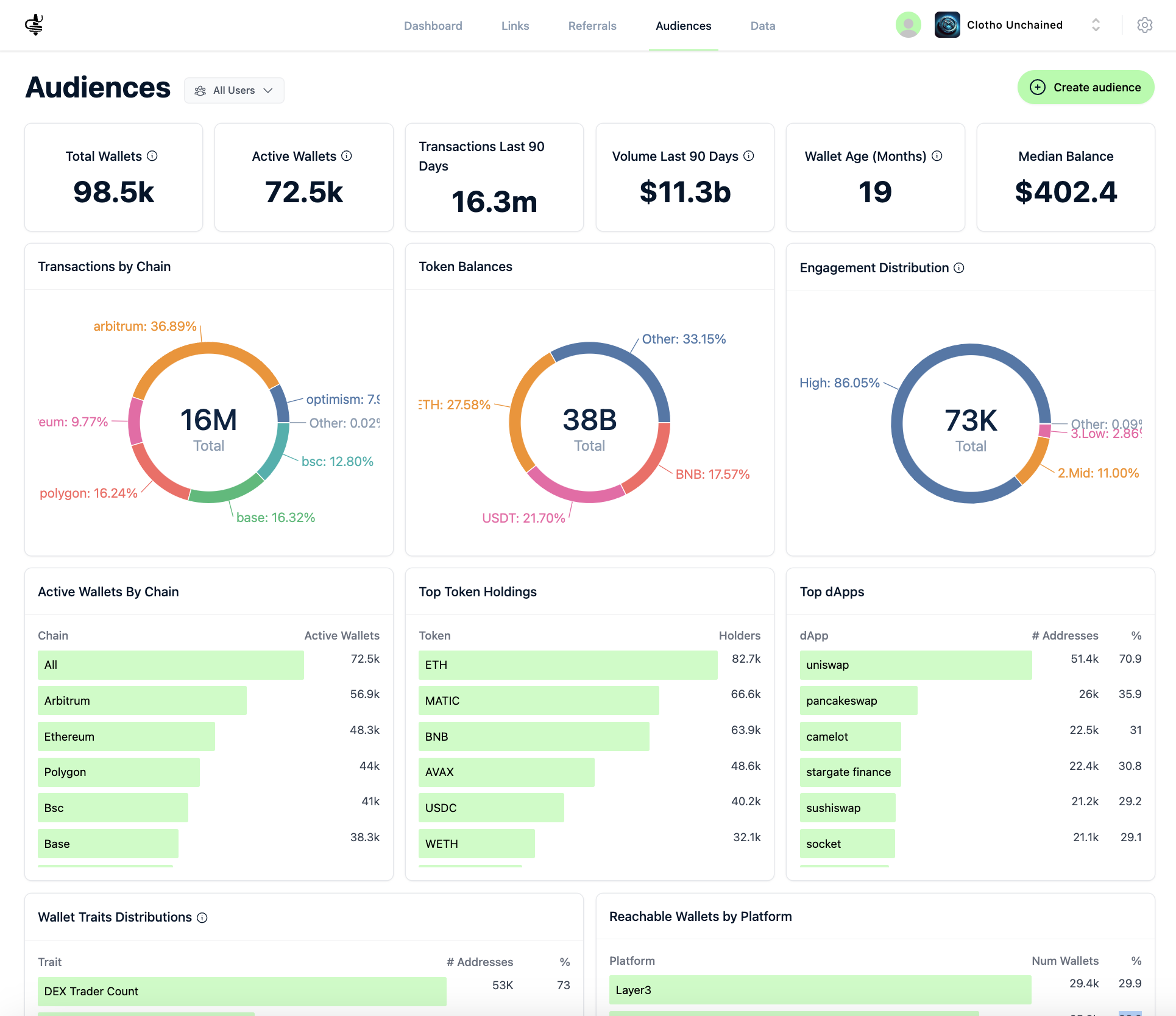
Here's a very typical overview of a protocol's entire active users, with basic stats like size, active wallets (defined as MTWs), transactions, median balance, etc. \
\
Note also the donut charts for transactions by chain, token balances and (importantly) the engagement distribution of users (**including a Sybil model).**&#x20;

<figure><img src="https://1560216118-files.gitbook.io/~/files/v0/b/gitbook-x-prod.appspot.com/o/spaces%2FXCbRJugC9obtJ12iHKUB%2Fuploads%2FyB5wpIEuOlweumzxNRAD%2FScreenshot%202024-05-01%20at%206.52.12%E2%80%AFPM.png?alt=media&#x26;token=5e7c91fc-dcc4-4a3e-b8f6-289037d0a50c" alt=""><figcaption></figcaption></figure>

But first, how to create an audience (other than your default one of every user).&#x20;


---

# Agent Instructions: Querying This Documentation

If you need additional information that is not directly available in this page, you can query the documentation dynamically by asking a question.

Perform an HTTP GET request on the current page URL with the `ask` query parameter:

```
GET https://docs.spindl.xyz/spindl/features/audiences.md?ask=<question>
```

The question should be specific, self-contained, and written in natural language.
The response will contain a direct answer to the question and relevant excerpts and sources from the documentation.

Use this mechanism when the answer is not explicitly present in the current page, you need clarification or additional context, or you want to retrieve related documentation sections.